Hexels 2 Isometry Tools - Design & Studies
These are my initial studies into the types of isometric art Hexels is capable of, and some UI/icon design for presenting isometry tools to the user.
Each hexagon in a hexel grid can be split into 6 triangles (trixels). Trixels are handy for drawing isometric planes, walls, cubes, and pillars. Splitting trixels down the middle in one of three ways also allows for angled isometric ramps to be drawn. In essence you are slicing the isometric cube diagonally at various angles. And if each trixel were to be split in all three ways at once (shards) ... really cool stuff starts to happen!
There are 3 main facets of the isometric cube and an aditional 7 angled ramps that can be represented in a complete isometric gem. In addition, both top-down and bottom-up perspectives on these shapes is possible. And through clever [mis]use of shards, one can even reconstruct left-to-right and right-to-left cubic isometry.
Also, I'm making all these terms up.
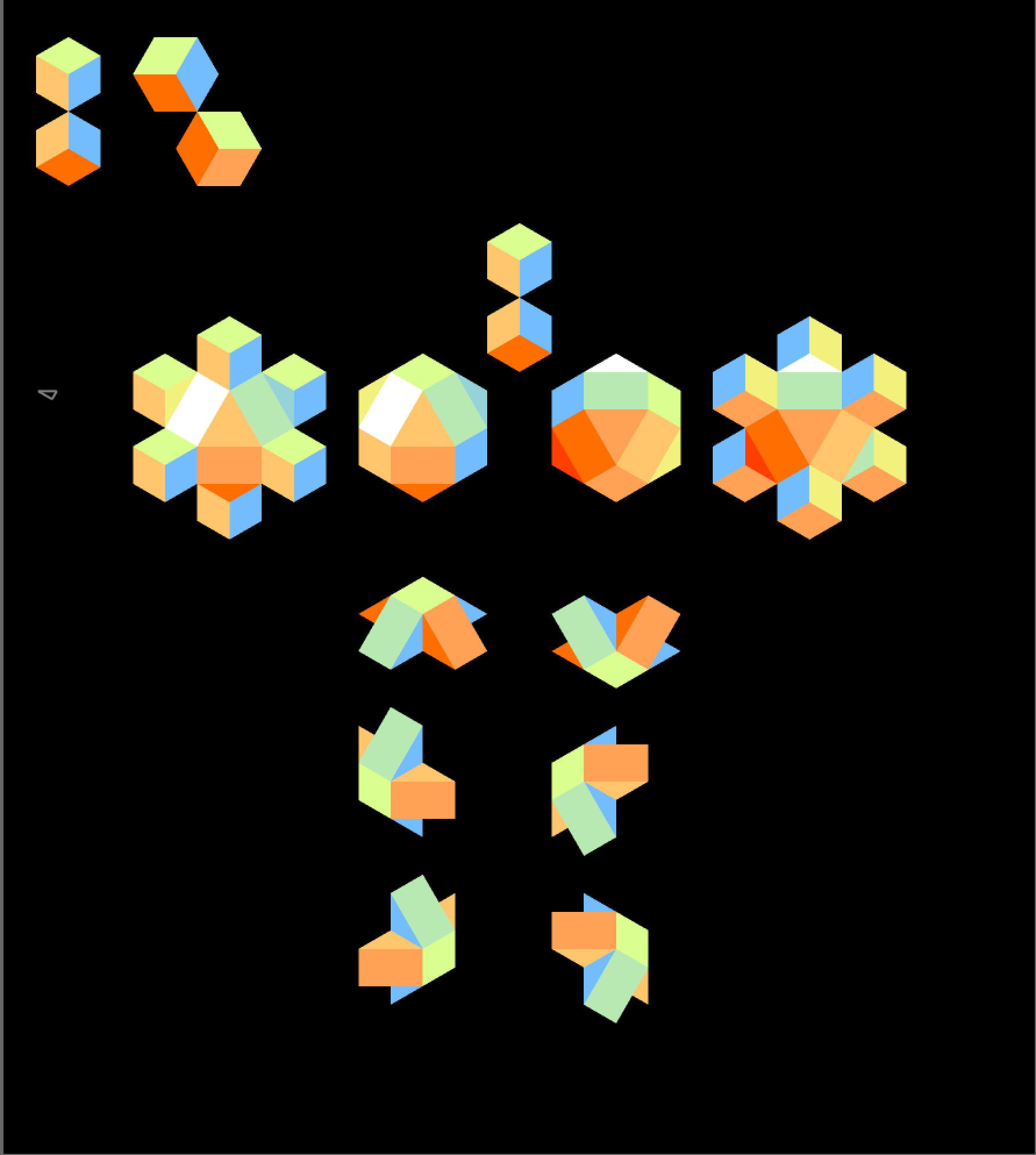
Initial study into the complete set of isometric shapes Hexels can handle. These were mind-bendingly fun to draw.

Concept for trixel brush palette. Each wedge highlighted in blue represents the selected subdivision of the trixel grid.

Second concept of the trixel brush palette. Trixel "gems" for the kinds of isometric shapes each brush is intended for.